
Personal training vs group training comes down to two things: how much one on one attention you need, and what helps you keep showing up. Personal training gives you a coach's full focus for the whole session. Small group training gives you a coach's guidance, a lower cost, and people to train beside.
The best format is the one you can stick with for years. At OPEX Round Rock, you get your own coach and your own program, and you train alongside a small group of like minded people. Here is how the two formats compare, what the research says, and how to choose.
What does personal training include?
Personal training means one coach working with one client at a time. Every rep, every adjustment, and every conversation is about you.
That focus matters most when your needs are specific. It tends to suit people coming back from an injury (clear it with your doctor or physical therapist first), people with an unusual schedule, people who feel nervous exercising around others, and anyone chasing a very specific goal that shifts week to week.
The tradeoff is cost. You are paying for all of your coach's time, so one on one sessions usually cost more per hour than a group.
What is small group training?
Small group training means a coach leads a handful of people through a session together. You get shared energy, built in accountability, and a lower price per person because the coach's time is split.
Quality varies a lot here. Some small group sessions hand everyone the same workout. Others give each person a program matched to their body, goals, and experience. The second version asks more of the coach, and it is the one worth looking for.
Small group training tends to suit people who stay consistent when others expect them, who enjoy the energy of training next to someone, and who want coaching at a price that is easier to sustain. It works best if you are comfortable with a coach splitting attention across a few people.
The best setups combine the two, with a group for energy and a program built around you.
What does the research say about personal vs group training?
Both formats work, and the research points to support and consistency as the deciding factors.
A meta analysis of 44 physical activity studies (Burke and colleagues, 2006) compared exercise settings across outcomes that included adherence and quality of life. Groups built to create real cohesion beat standard exercise classes. Home programs with regular contact from a professional beat home programs without it. Contact and social support made the difference.
A 2017 study in the Journal of Strength and Conditioning Research looked at a studio that combines personal training with a small group setting, where each person trains with 1 to 5 other adults on an individualized program. Members who were more satisfied with that format reported stronger motivation from within, more confidence in their ability to exercise, and greater life satisfaction. It was a survey of 98 members, so it shows an association rather than proof of cause.
Neither format wins on its own, so pick the one you will keep showing up for.
How do we combine personal and small group training at OPEX Round Rock?
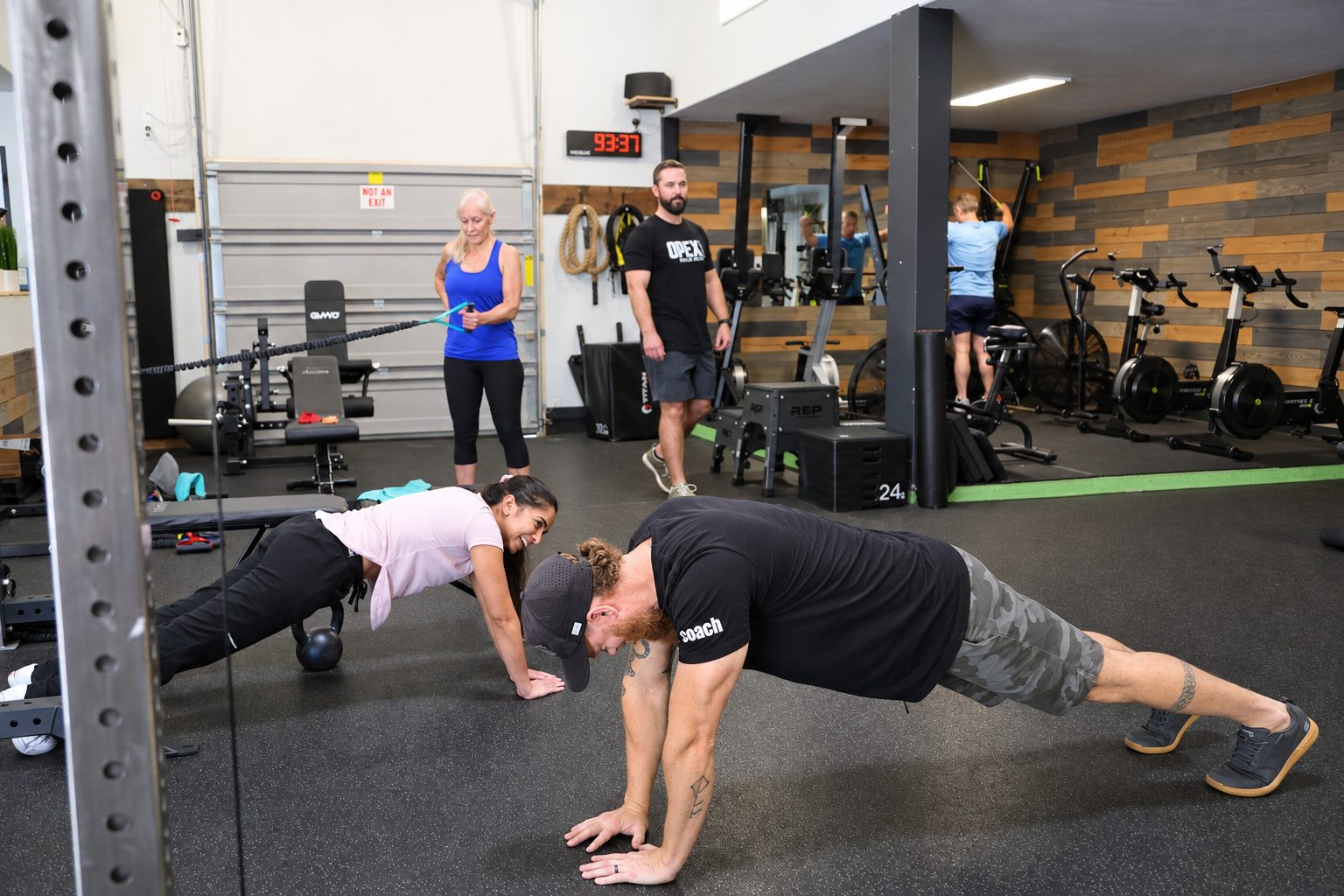
At OPEX Round Rock, we build personalized programming and deliver it in a small group setting. Every client has their own coach who designs their workouts and nutrition plan. On the floor, you train alongside other clients while a coach watches your form and corrects your technique as you move.
It starts with a free consult, a one on one conversation about your goals, motivations, fitness history, and schedule. A physical assessment follows, and your coach uses it to write your program. From there, your program arrives weekly in the CoachRx app, and every four weeks you review progress with your coach and adjust the plan.
That ongoing adjustment is the point. We design training that fits into your real life, so a busy month, a sore shoulder, or a new goal changes the plan. You do not start over.
We coach people at every fitness level, so beginners and experienced lifters train in the same room, each on their own program. We personalize the group training experience.
How do you choose between personal training and small group training?
Start with what has gotten in the way before. If plans never fit your life, or nobody noticed when you struggled, you need a coach who writes and adjusts a program around you. If training alone wore you down, you need people around you. The setup worth looking for gives you both, with a program built for you and a small group to train alongside.
Then ask any gym these four questions:
Who writes my program, and is it different from the person next to me?
How often will my coach adjust it as my life changes?
How many people does one coach lead at a time?
Who corrects my form while I train?
The answers show you whether a small group is really personal training shared, or a class with a smaller headcount.
Personal training vs small group training FAQ
Is small group training as effective as personal training?
Yes, when each person trains on an individualized program with a coach who adjusts it. Results come from the quality of the plan and how consistently you show up, more than from the number of people in the room.
Which costs less, personal training or small group training?
Small group training usually costs less per person, since the coach's time is shared. Ask what is included, such as assessments, programming, and check ins, before you compare prices.
How big is too big for a small group?
A group is too big when your coach cannot keep an eye on your form throughout the session. Ask how many people one coach leads at a time.
Do I need to be fit before I start?
No. You can start at any fitness level. We build your program from your assessment, so it begins where you are today.
Ready to find your fit?
Book a free consult with us at OPEX Round Rock, 514 E. Palm Valley Blvd. in Round Rock. You will sit down with a coach, talk through your goals, history, and schedule, and leave with a clear picture of what training could look like for you.